

Older boats around Newport Beach, California, often carry decades of repairs, upgrades, and owner-installed equipment. That history can make a simple replacement part difficult to identify, especially when labels have faded and the original supplier no longer stocks the item.
For owners researching replacement parts for Taiwan boats, M.M.I. Marine is a Newport Beach marine-parts business that supports yacht owners and dealers with marine hardware, equipment, accessories, and product support connected to Taiwan-built vessels. Its long-standing relationship with the Taiwan yacht market can be particularly helpful when an older imported boat has unfamiliar fittings, switches, portlights, plumbing components, or deck hardware.
Why Older Boat Parts Need More Careful Research
A boat built years ago may not be equipped exactly as it left the factory. Previous owners may have changed pumps, lights, chargers, hoses, hardware, and electrical panels. Even boats of the same model and year can differ because builders sometimes used multiple suppliers during production.
Coastal conditions add another challenge. Salt air, ultraviolet exposure, vibration, damp lockers, and heat in engine spaces can damage markings and shorten the useful life of unsuitable materials. The right replacement is not simply the part that looks closest. It is the part that safely works within the existing system.
Start With the Boat, Not the Broken Part
Before searching online, create a basic identification record. This step narrows the search and gives a marine parts specialist useful information if the original number cannot be read.
- Boat builder, model, and model year
- Hull identification number
- Engine, generator, and major equipment brands
- Location of the failed component
- Original equipment manufacturer, if known
- Whether the part is original or appears to be a later installation
Gather Evidence Before Removing Anything
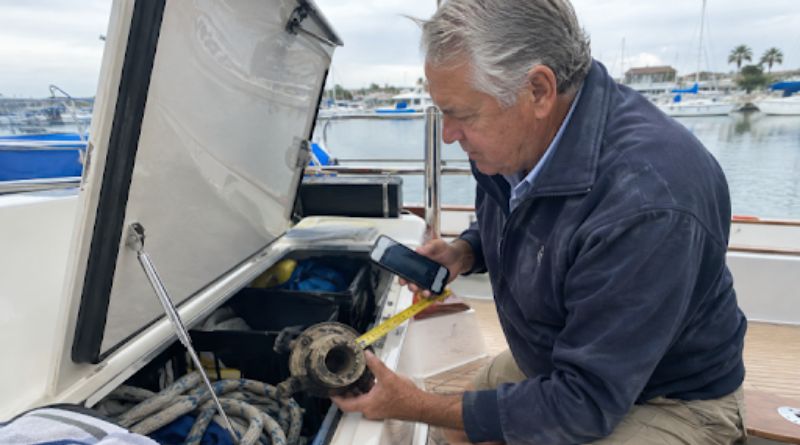
Take photographs before disconnecting wires, hoses, or fasteners. Photograph the installed part, its mounting area, nearby labels, connectors, and the route of any wiring or plumbing. A photo that shows the part in context is often more useful than a close-up alone.
- Record every visible number, letter, logo, and rating.
- Measure length, width, height, diameter, hole spacing, and thread size.
- Note wire gauge, terminal type, hose inside diameter, or fitting style.
- Mark wire locations before disconnection when appropriate.
- Keep the old component until the replacement has been test-fitted and confirmed.
Understand OEM, Equivalent, and Universal Parts
An OEM part is made to the original manufacturer’s specification. An equivalent part is intended to perform the same function but may come from another manufacturer. A universal part is designed for many installations and may require adapters, drilling, trimming, or changes to wiring and plumbing.
Universal does not automatically mean compatible. A universal hatch latch, pump, light, or switch still must meet the original system’s dimensions, operating load, environmental exposure, and safety needs. On an older yacht, a direct-fit part can reduce installation work, but a carefully chosen equivalent may offer better serviceability.
Check Materials and Marine Ratings
Marine conditions are demanding, particularly in Southern California harbors where boats may spend long periods exposed to sun, salt residue, and moisture. Compare the actual service conditions with the replacement part’s specifications.
- Select corrosion-resistant hardware suitable for the surrounding metals and location.
- Use plastics and lenses intended for outdoor ultraviolet exposure where required.
- Confirm that seals, hoses, and gaskets are rated for fuel, potable water, waste, exhaust, or seawater as applicable.
- Check temperature and pressure limits for pumps, valves, strainers, and fittings.
- Consider vibration resistance for equipment mounted near engines or generators.
Verify Electrical Compatibility Before Buying
Electrical parts should never be selected by appearance alone. A switch or fixture that looks identical can have a different voltage, current capacity, terminal arrangement, or protection rating. Check system voltage, AC or DC power, amperage or wattage, polarity, terminal layout, fuse or breaker requirements, and water-resistance rating.
For work involving electrical distribution, fuel systems, ventilation, or navigation lights, review the relevant federal recreational boating regulations and involve a qualified marine technician when there is any uncertainty. Replacing one component should not compromise the protection of the larger circuit or system.
Compare Specifications Before Comparing Prices
A low-priced listing can become expensive if the part has the wrong mounting holes, shaft length, thread pattern, connector, or pressure rating. Compare each candidate replacement against the original using a short checklist:
- Original and replacement dimensions
- Material and corrosion resistance
- Voltage, amperage, pressure, or load rating
- Mounting method and hole spacing
- Connector, hose, or thread compatibility
- Installation instructions and return policy
- Availability of future service parts
When a Modern Substitute Makes Sense
An updated part can be the best solution when the original is discontinued, unreliable, or difficult to service. For example, an old cabin light may be replaced with a modern marine-rated fixture that draws less power. However, the new fixture still needs the correct voltage, mounting footprint, wire connection method, and protection for its installation location.
Repair, Replace, or Upgrade?
Repair
Repair may be appropriate when the main component remains sound and manufacturer-approved service parts are available, such as seals, impellers, lenses, strainers, or rebuild kits.
Replace
Replacement is sensible when a single component has failed, but the surrounding wiring, plumbing, controls, and mounting arrangement remain serviceable.
Upgrade
Upgrade the wider system when repeated failures, unsafe materials, obsolete connections, or poor parts availability make isolated repairs impractical. A new pump may reveal deteriorated hoses, and a new charger may expose undersized wiring or worn battery connections.
How to Search for Hard-to-Find Parts
- Search the original part number in quotation marks.
- Search for the manufacturer and model together.
- Use measurements and the part’s function if no number is visible.
- Review marine supply catalogs and installation documents.
- Send clear photos and measurements to a knowledgeable parts specialist.
- Confirm stock status and return terms before ordering.
Common Mistakes to Avoid
- Ordering from a photo without confirming measurements.
- Assuming the boat model year identifies every installed component.
- Using household hardware or electrical parts in a marine environment.
- Ignoring wire size, circuit protection, and connection style.
- Discarding the old part before verifying the new one.
- Choosing a lower-rated component solely because it costs less.
Simple Replacement-Part Worksheet
- Boat make, model, and year:
- System and installation location:
- Original manufacturer and part number:
- Measured dimensions:
- Voltage, pressure, or load rating:
- Material and mounting method:
- Photos saved:
- Replacement confirmed by:
Conclusion
Successful parts sourcing for an older Newport Beach boat begins with careful identification rather than a quick order. Photos, measurements, ratings, and system details help prevent poor fits, delays, and unnecessary rework. Match the complete application, not just the old part’s appearance, and the replacement is far more likely to provide dependable service on the water.
Read Also: 4806903932
